
 Pусский
 Deutsch
 Français
 Portugues
 Español
 العربية
 lingua italiana
 日本語
日本語 한국어
한국어 Türk dili

Crafting power inductors, including toroidal power inductors, requires a methodical approach and attention to detail to ensure optimal performance and reliability. In this detailed overview, we will explore the main steps involved in making power inductors, from selecting the magnetic material to calculating temperature rise.
The first step in crafting power inductors is to select the appropriate magnetic material for the core. This choice significantly influences the inductor's performance characteristics, such as permeability, coercivity, and resistivity. Commonly used magnetic materials for power inductors include silicon steel, ferrite, amorphous alloy, ultrafine crystal, precision alloy, and magnetic powder core. Each material has its advantages and limitations, necessitating careful consideration based on the specific application requirements.
Once the magnetic material is chosen, the next step is to select a core type and determine the core structure. Toroidal cores are often preferred for their efficient magnetic flux path and compact design. However, the specific core type and structure depend on factors such as operating frequency, power rating, and space constraints within the application.
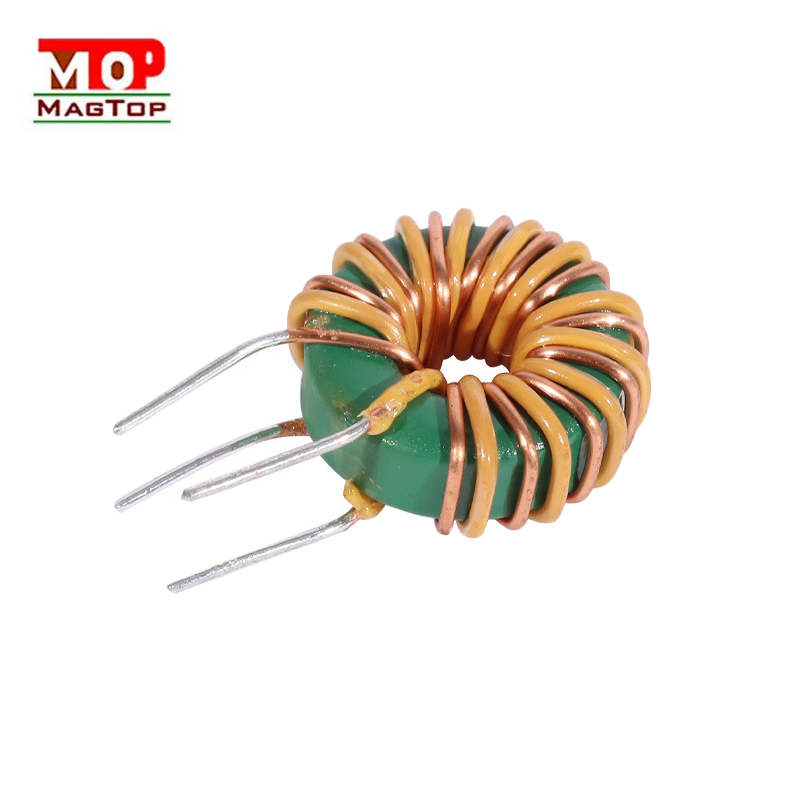
After determining the core, the air gap length and coil structure must be designed. The air gap length influences the inductor's inductance and saturation characteristics, while the coil structure affects factors such as magnetic field distribution and winding capacitance. These parameters must be carefully optimized to achieve the desired electrical performance.
Selecting the appropriate wire type is crucial for minimizing losses and maximizing efficiency in power inductors. For low-frequency applications, round copper wires or thin copper tapes are commonly used. However, for high-frequency applications, wire bundles may be employed to reduce eddy current losses and improve overall efficiency.
Finally, temperature rise calculation ensures that the inductor operates within safe temperature limits under varying load conditions. Factors such as core material, wire size, and ambient temperature must be considered to accurately predict temperature rise and prevent thermal issues that could compromise the inductor's performance.
In conclusion, crafting power inductors requires careful consideration of various design parameters and a systematic approach to ensure optimal performance and reliability. By following the steps outlined in this overview, engineers can produce high-quality power inductors that meet the demanding requirements of modern electronic applications.


