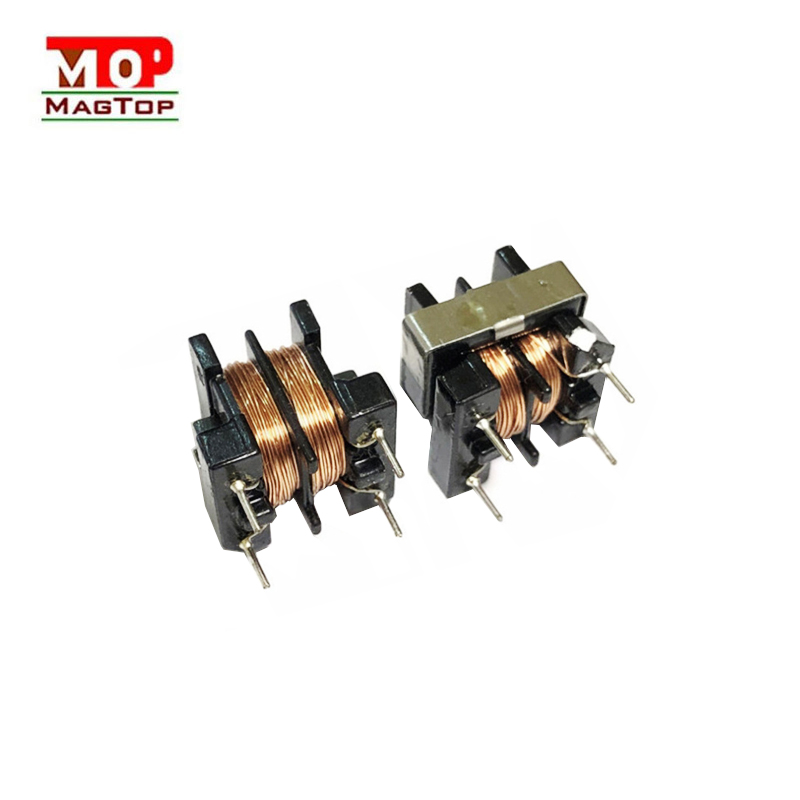
Using LISN to Analyze Common Mode Choke Saturation Behavior
Using LISN to Analyze Common Mode Choke Saturation Behavior
author: MagTop
13/05/2026Industry News
Measuring saturation in common mode chokes is challenging. LISN allows observation of attenuation reduction caused by 60Hz currents. The oscilloscope monitors line voltage via channel A at 2ms/div, triggering at voltage peaks. Current flow can temporarily reduce filter efficiency. DMRN connects the LISN to channel B, 50Ω matched. Emission rises 6–10dB in linear operation.
At saturation, emission increases, with full saturation potentially exceeding 40dB. The degradation factor, peak/min emission, evaluates the effect of line current on filtering. A typical efficient filter has a factor of 2–4. Causes include inductance reduction from 60Hz current and bridge rectifier forward/reverse effects. Flugan applied this method to minimize ballast emissions.

 Pусский
 Deutsch
 Français
 Portugues
 Español
 العربية
 lingua italiana
 日本語
日本語 한국어
한국어 Türk dili