Pусский
 Deutsch
 Français
 Portugues
 Español
 العربية
 lingua italiana
 日本語
日本語 한국어
한국어 Türk dili

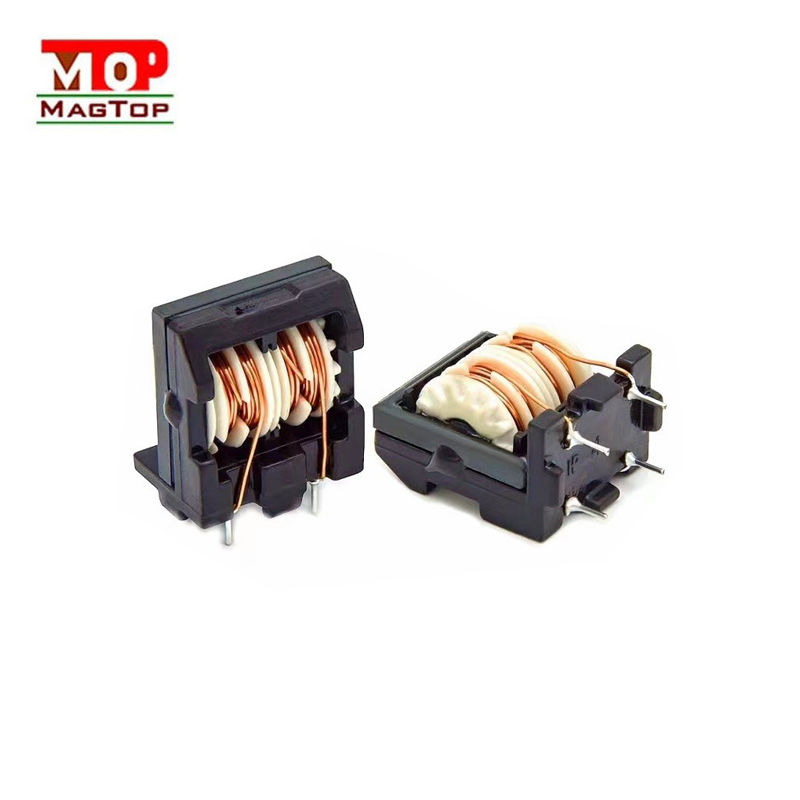
Testing common mode choke cores for saturation is often difficult. Using the LISN principle, engineers can monitor the effect of 60Hz line current on filter performance. An oscilloscope tracks voltage on channel A, with 2ms/div time reference and trigger signal applied.
Peak AC voltage produces wired current, potentially reducing filter efficiency. The DMRN connects between the LISN and oscilloscope channel B with 50Ω impedance. In the linear operation, emission rise is 6–10dB. Saturation causes emission spikes up to 40dB. The ratio of peak to minimum emission, called the degradation factor, evaluates line current effects, typically 2–4 for efficient filters.
Factors include reduced inductance from charging current and bridge rectifier forward/reverse action. Flugan implemented this approach to minimize ballast conduction emissions.
Peak AC voltage produces wired current, potentially reducing filter efficiency. The DMRN connects between the LISN and oscilloscope channel B with 50Ω impedance. In the linear operation, emission rise is 6–10dB. Saturation causes emission spikes up to 40dB. The ratio of peak to minimum emission, called the degradation factor, evaluates line current effects, typically 2–4 for efficient filters.
Factors include reduced inductance from charging current and bridge rectifier forward/reverse action. Flugan implemented this approach to minimize ballast conduction emissions.