Pусский
 Deutsch
 Français
 Portugues
 Español
 العربية
 lingua italiana
 日本語
日本語 한국어
한국어 Türk dili

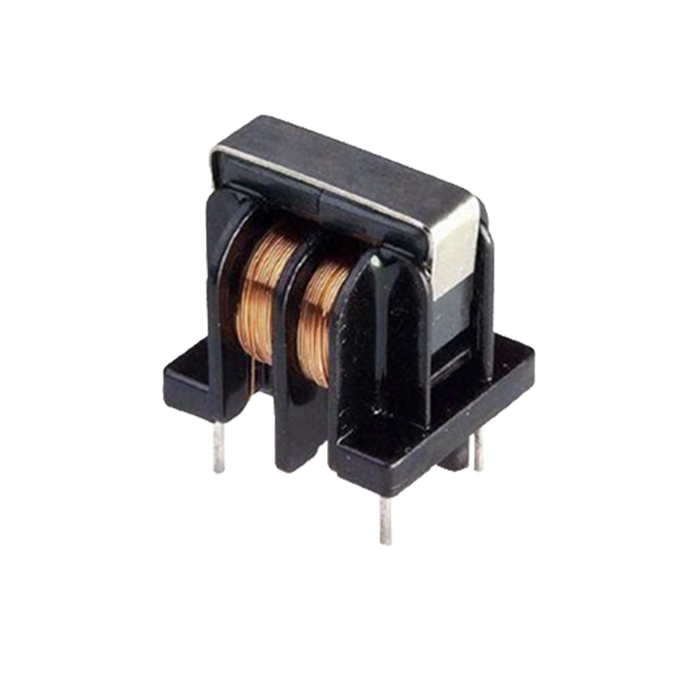
Measuring the saturation characteristics of a common mode choke core can be challenging. The LISN principle provides a straightforward test to observe how attenuation is affected by a 60Hz line current. An oscilloscope and a differential mode suppression network (DMRN) are required. Channel A of the oscilloscope monitors line voltage, with time set to 2ms/div.
When the AC voltage peaks, the wired current flows, possibly degrading filter efficiency. The DMRN input is connected to the LISN, and its output goes to channel B with a 50Ω impedance. In the linear region, emission increment is limited to 6–10dB. Saturation leads to increased emissions, with full saturation possibly exceeding 40dB.
The degradation factor, defined as the ratio of peak emission to minimum emission, measures the effect of line current bias. A typical good filter has a factor of 2–4, influenced by 60Hz-induced inductance reduction and bridge rectifier behavior. Flugan applied this principle to reduce ballast conduction emission.
When the AC voltage peaks, the wired current flows, possibly degrading filter efficiency. The DMRN input is connected to the LISN, and its output goes to channel B with a 50Ω impedance. In the linear region, emission increment is limited to 6–10dB. Saturation leads to increased emissions, with full saturation possibly exceeding 40dB.
The degradation factor, defined as the ratio of peak emission to minimum emission, measures the effect of line current bias. A typical good filter has a factor of 2–4, influenced by 60Hz-induced inductance reduction and bridge rectifier behavior. Flugan applied this principle to reduce ballast conduction emission.