Pусский
 Deutsch
 Français
 Portugues
 Español
 العربية
 lingua italiana
 日本語
日本語 한국어
한국어 Türk dili

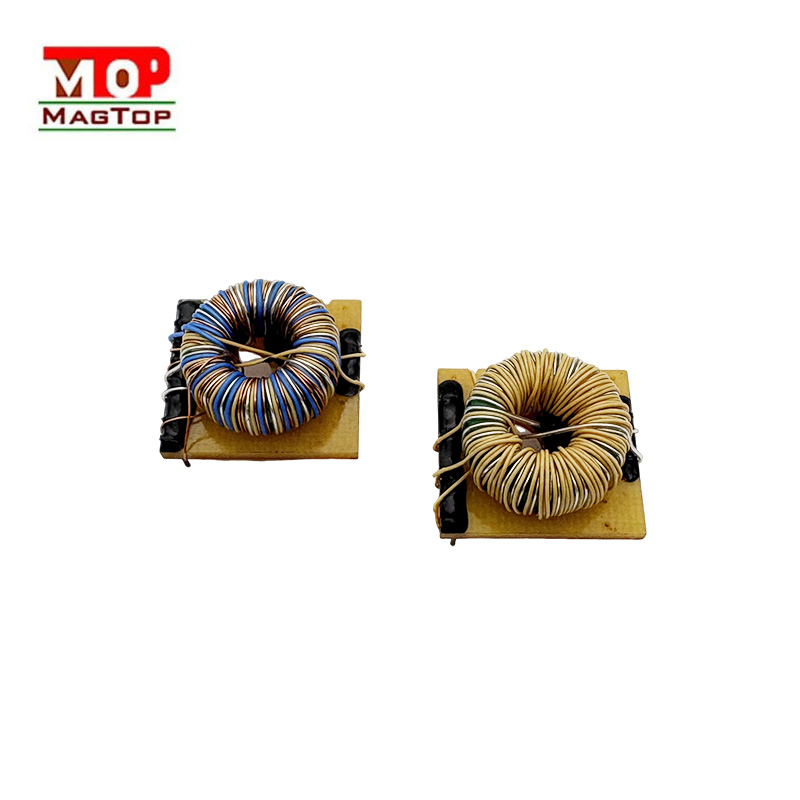
As electronic devices become increasingly compact and power-dense, electromagnetic compatibility (EMC) requirements continue to rise. Common mode chokes remain one of the most important components for controlling conducted emissions, but their performance can decline when magnetic saturation occurs.
Advanced saturation analysis methods, including LISN-based testing and current probe measurements, allow engineers to evaluate actual filter behavior under realistic operating conditions.
When a bridge rectifier conducts during peak line voltage, charging current creates a magnetic bias in the common mode choke core. If the core material cannot handle this current level, inductance decreases and EMI suppression capability deteriorates.
The equivalent circuit analysis shows that common mode emission behavior is influenced by source impedance, rectifier characteristics, and LISN common mode impedance. The reverse bias capacitance of the diode bridge also affects filtering performance, especially during reverse conduction conditions.
The expected inherent degradation factor is approximately 2, although actual results depend on circuit parameters and component characteristics.
By applying these testing methods during product development, engineers can optimize:
Magnetic core material selection
Winding structure
Saturation margin
EMI suppression capability
Overall system reliability
These improvements are essential for power supplies, industrial electronics, automotive systems, and other high-performance applications requiring stable electromagnetic performance.
Advanced saturation analysis methods, including LISN-based testing and current probe measurements, allow engineers to evaluate actual filter behavior under realistic operating conditions.
When a bridge rectifier conducts during peak line voltage, charging current creates a magnetic bias in the common mode choke core. If the core material cannot handle this current level, inductance decreases and EMI suppression capability deteriorates.
The equivalent circuit analysis shows that common mode emission behavior is influenced by source impedance, rectifier characteristics, and LISN common mode impedance. The reverse bias capacitance of the diode bridge also affects filtering performance, especially during reverse conduction conditions.
The expected inherent degradation factor is approximately 2, although actual results depend on circuit parameters and component characteristics.
By applying these testing methods during product development, engineers can optimize:
Magnetic core material selection
Winding structure
Saturation margin
EMI suppression capability
Overall system reliability
These improvements are essential for power supplies, industrial electronics, automotive systems, and other high-performance applications requiring stable electromagnetic performance.