
 Pусский
 Deutsch
 Français
 Portugues
 Español
 العربية
 lingua italiana
 日本語
日本語 한국어
한국어 Türk dili

Besides LISN-based analysis, current probe technology provides an alternative method for investigating the saturation behavior of common mode chokes.
This approach is similar to the testing principle used in MIL-STD-461 electromagnetic compatibility evaluations. The system uses two current probes: one low-frequency probe monitors the input line current, while a high-frequency probe measures common mode emission current.
The monitored line current acts as the trigger signal, allowing engineers to observe how EMI performance changes as the choke approaches magnetic saturation.
However, engineers must carefully consider one important challenge: current probe measurements can be affected by differential mode current leakage caused by winding symmetry. Poor winding arrangement may reduce measurement accuracy because differential mode components can interfere with common mode emission results.
To improve measurement reliability, two techniques are commonly applied:
Installing a high-order high-pass filter with a 6kHz cutoff frequency between the probe signal and oscilloscope.
Connecting wires between each 10μF capacitor and the power bus, then placing the current probe near these wires where line current interference is minimized.
With proper test setup and winding design, current probe measurements can achieve approximately 30dB differential mode current attenuation, providing engineers with accurate information about choke saturation performance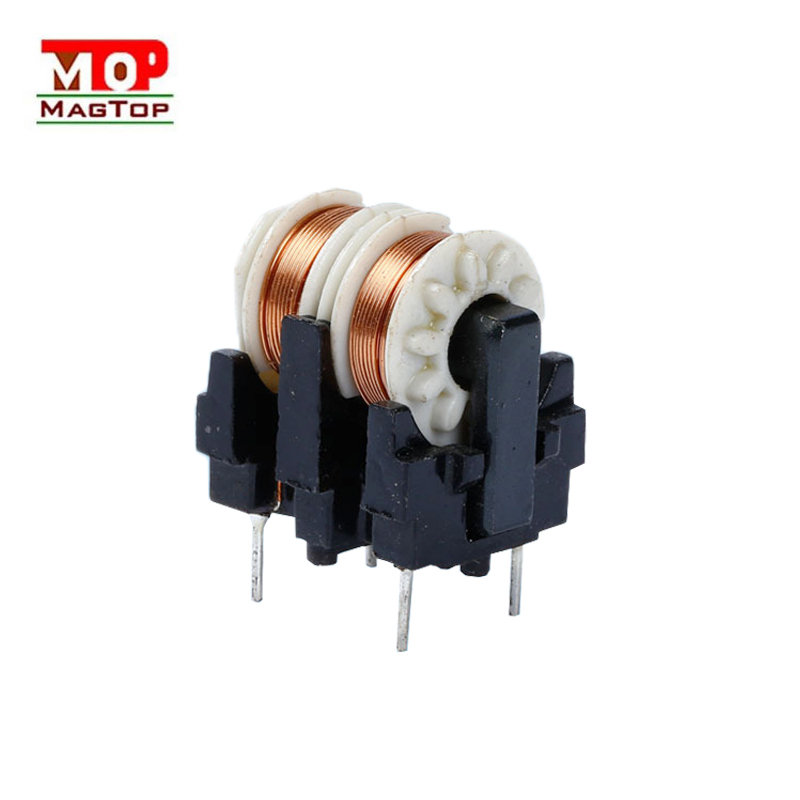
This approach is similar to the testing principle used in MIL-STD-461 electromagnetic compatibility evaluations. The system uses two current probes: one low-frequency probe monitors the input line current, while a high-frequency probe measures common mode emission current.
The monitored line current acts as the trigger signal, allowing engineers to observe how EMI performance changes as the choke approaches magnetic saturation.
However, engineers must carefully consider one important challenge: current probe measurements can be affected by differential mode current leakage caused by winding symmetry. Poor winding arrangement may reduce measurement accuracy because differential mode components can interfere with common mode emission results.
To improve measurement reliability, two techniques are commonly applied:
Installing a high-order high-pass filter with a 6kHz cutoff frequency between the probe signal and oscilloscope.
Connecting wires between each 10μF capacitor and the power bus, then placing the current probe near these wires where line current interference is minimized.
With proper test setup and winding design, current probe measurements can achieve approximately 30dB differential mode current attenuation, providing engineers with accurate information about choke saturation performance


