
 Pусский
 Deutsch
 Français
 Portugues
 Español
 العربية
 lingua italiana
 日本語
日本語 한국어
한국어 Türk dili

High-frequency transformers, operating above 10kHz, are pivotal in efficient power supplies. They convert high-frequency pulses to AC, with specific core diameter considerations for customized applications
A high-frequency transformer is a specialized type of power transformer with a working frequency exceeding the medium-frequency range, typically above 10kHz. These transformers find application primarily as key components in high-frequency switching power supply transformer.
They are also employed in high-frequency inverter power supplies and high-frequency inverter welding machines. High-frequency transformers are categorized based on their operating frequencies, including 10kHz-50kHz, 50kHz-100kHz, 100kHz-500kHz, 500kHz-1MHz, and 10MHz and above.

Significance in High-Frequency Power Supplies High-frequency transformers play a pivotal role in the realm of switching power supplies. Within the domain of switching power supplies, there exist various circuit topologies. For instance, consider the half-bridge power conversion circuit.
In this configuration, two switching transistors activate alternately to generate a high-frequency pulse waveform, typically at 100kHz. This high-frequency signal is then processed through the high-frequency transformer to produce alternating current.
The ratio of turns in each winding coil of the high-frequency transformer determines the output voltage. In a typical half-bridge transformer circuit, three primary high-frequency transformers are noticeable: the main transformer, the standby transformer, and the auxiliary transformer.
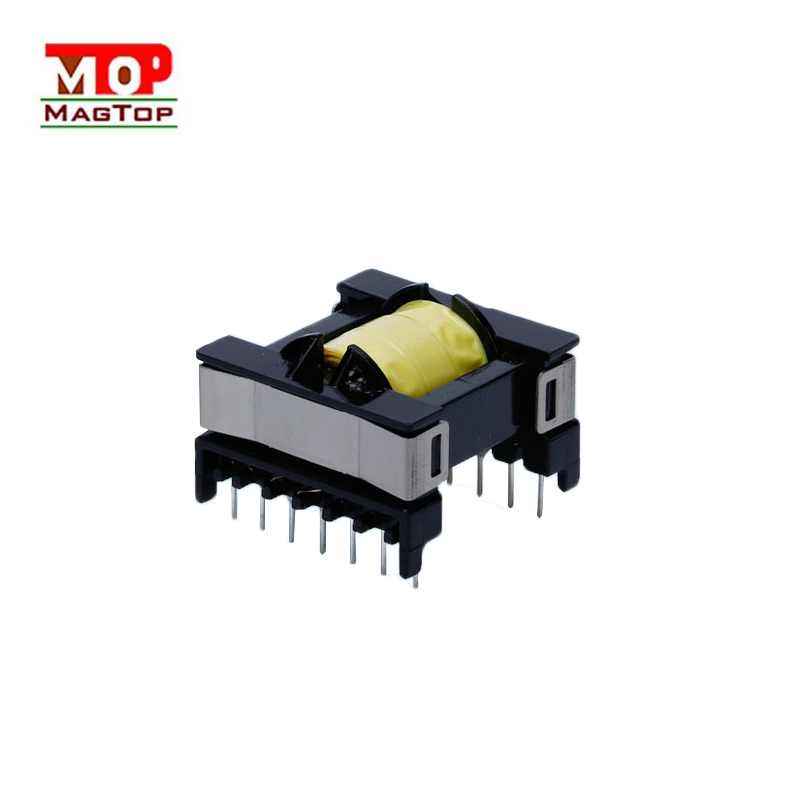
Each of these transformers has specific guidelines governing its design. For instance, the main transformer should have a core diameter (cross-sectional size) of no less than 35mm for power supplies exceeding 200W. In contrast, the auxiliary transformer, used for power supplies up to 300W, requires a core diameter of 16mm, demonstrating the importance of tailored transformer specifications in various applications.


