Pусский
 Deutsch
 Français
 Portugues
 Español
 العربية
 lingua italiana
 日本語
日本語 한국어
한국어 Türk dili

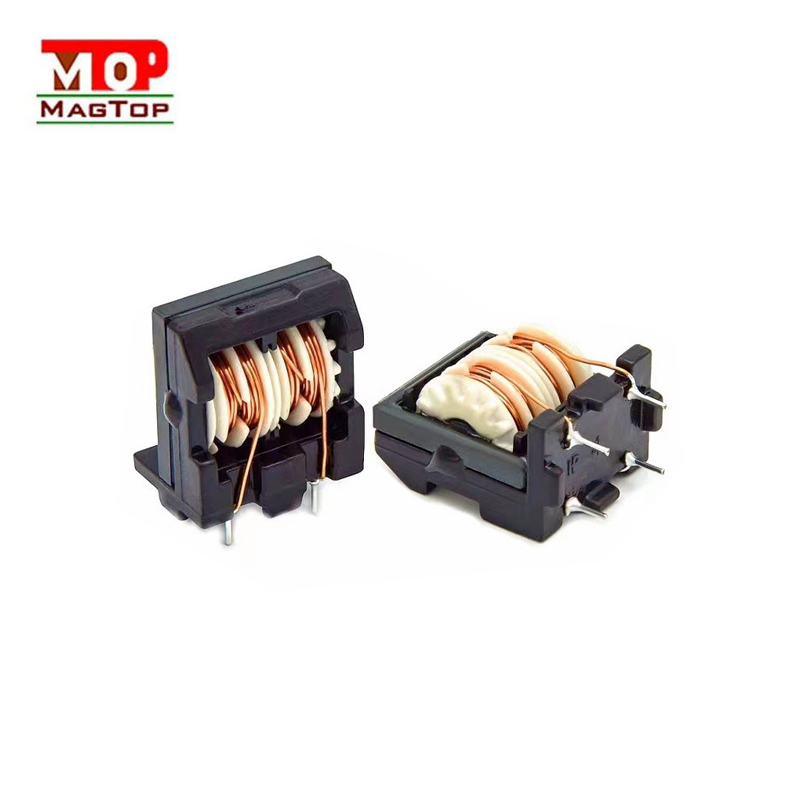
When designing and selecting common mode choke filters, the key parameters to consider include rated current, rated voltage, and cut-off frequency. The rated current represents the maximum allowable current through the filter. If this current is exceeded, the filter may overheat and its low-frequency filtering performance may deteriorate due to inductance saturation. To prevent this, it is recommended to select a filter with a rated current 1.5 times the actual operating current.
Rated voltage selection depends on whether the filter will be subjected to high-voltage impacts such as electrostatic discharge or electromagnetic pulses. If not, the circuit's working voltage can serve as the rated voltage. However, if the filter is likely to encounter such high-voltage impacts, especially for external cables, it is crucial to factor in these conditions and ensure the rated voltage provides a sufficient safety margin.
The cut-off frequency should be chosen to ensure that the filter's passband adequately covers the signal bandwidth, allowing for normal operation while filtering out unwanted high-frequency noise. For analog signals, the cutoff frequency should be greater than the signal's bandwidth. For digital pulse signals, the cutoff frequency can be set to 1/tr, where tr is the rise/fall time of the pulse. For periodic pulse signals, a cutoff frequency of 15 times the pulse repetition frequency is usually appropriate.
By carefully considering these parameters—rated current, rated voltage, and cut-off frequency—engineers can optimize the performance and reliability of common mode choke filters in various applications.